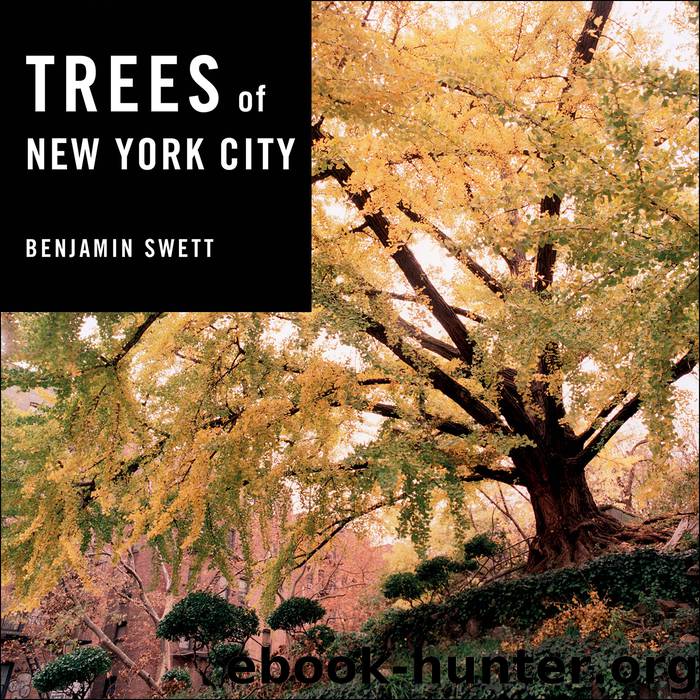
Trees of New York City by Benjamin Swett
Author:Benjamin Swett
Language: eng
Format: epub
Publisher: Countryman Press
Published: 2017-04-08T04:00:00+00:00
Tanyosho Pine Pinus densiflora ‘Umbraculiferas’ 24"
Ross Conifer Arboretum, New York Botanical Garden, Bronx
May 5, 2009
The four tanyosho pines growing across from the reflecting pool near the Conservatory Gate at the New York Botanical Garden are what is left of an original grove of six planted in 1908. Pines like these have been cultivated in Japan for centuries to highlight the intense color of the bark and the flat, layered way the branches spread out. One of the traditional goals of Japanese gardeners was to create small spaces that would give the effect of larger or different ones. Because they were planted so close together so long ago, the four tanyosho pines have grown in tandem as if they were a single plant, each one dependent on the others to block wind and limit the sway of branches. Fallen needles around the trunks have decayed into a loamy layer that matches the color of the bark and also fertilizes the trees. As the branches have risen and spread a clear space has opened beneath in which trunks and limbs seem like supporting structures of a soft red room. The tanyosho form their own system within the larger framework of the garden’s conifer arboretum, which itself contains many other trees with similarly unusual and alluring qualities. Spiraling out from the Victorian glass Conservatory, the conifer collection was one of the first arrangements of trees put in the ground after the garden opened in 1896. At that time, all of the trees except those in the fifty-acre forest were arranged according to their evolutionary relationships: pines with pines, oaks with oaks, maples with maples. This was thought to be the most educational, rational way to organize species. Whether a tree was a pure specimen as it would have been found in the wild or, like the tanyosho pines, a cultivated variety selected for a special trait mattered less than that it be in the same genus as its neighbor. Horticulturists now often experiment with different arrangements, but with their intense concentrations of similar plants the older collections retain a kind of breathtaking simplicity and integrity.
Download
This site does not store any files on its server. We only index and link to content provided by other sites. Please contact the content providers to delete copyright contents if any and email us, we'll remove relevant links or contents immediately.
Sapiens: A Brief History of Humankind by Yuval Noah Harari(14389)
The Tidewater Tales by John Barth(12659)
Mastermind: How to Think Like Sherlock Holmes by Maria Konnikova(7347)
The Thirst by Nesbo Jo(6944)
Do No Harm Stories of Life, Death and Brain Surgery by Henry Marsh(6941)
Why We Sleep: Unlocking the Power of Sleep and Dreams by Matthew Walker(6725)
Life 3.0: Being Human in the Age of Artificial Intelligence by Tegmark Max(5558)
Sapiens by Yuval Noah Harari(5371)
The Body: A Guide for Occupants by Bill Bryson(5097)
The Longevity Diet by Valter Longo(5064)
The Rules Do Not Apply by Ariel Levy(4969)
The Immortal Life of Henrietta Lacks by Rebecca Skloot(4588)
Animal Frequency by Melissa Alvarez(4473)
Why We Sleep by Matthew Walker(4447)
The Hacking of the American Mind by Robert H. Lustig(4383)
Yoga Anatomy by Kaminoff Leslie(4363)
All Creatures Great and Small by James Herriot(4322)
Double Down (Diary of a Wimpy Kid Book 11) by Jeff Kinney(4272)
Embedded Programming with Modern C++ Cookbook by Igor Viarheichyk(4179)
